Postdocs – Postdocs with their own funding or who would like to collaborate on a grant application are always welcome to contact me.
Ph.D. Students

Justice Saxby – Justice is interested in biogeochemical cycling in Earth’s major reservoirs and wants to investigate how Earth’s carbon sinks are changing and becoming less effective. She wants to use her findings in science-based policy development at the local, state, national, and global scale, and in turn, educate the public on how our habits are damaging to the environment and how to live more sustainably. She is committed to community outreach and conveying science in a way everyone can understand.
Justice grew up in Northeast Wisconsin right along Lake Michigan and received her undergraduate degree in Environmental Science at the University of Wisconsin-Green Bay. In her free time, Justice enjoys all things outdoors, cooking/baking, yoga, and crocheting. A fun fact about Justice: She got to fly a plane during a field campaign in Colorado during her internship with NOAA!

Pavlos Efthymiadis – Pavlos is from Athens, Greece and received his B.S. in Biology and M.S. in Environmental Biology from the University of Crete. For his B.S. thesis, he studied the effect of temperature on seagrass productivity, while his M.S. thesis focused on assessing the carbon sequestration capacity of seagrass meadows in the Greek Seas. After graduating, he worked as a research assistant at the Hellenic Centre for Marine Research, contributing to two projects focusing on measuring seagrass carbon stocks and accumulation rates. Prior to joining USU, he interned at Aarhus University in Denmark, where he studied the spatio-temporal variability of organic carbon sources in salt marsh soils. He is interested in studying carbon storage within vegetated coastal ecosystems to support their conservation and enhance their carbon sequestration potential for climate change mitigation. Outside the lab, he is always up for an adventure, whether it’s hiking, mountain biking, climbing, or just hanging out with good company (and good food)!
Masters Students
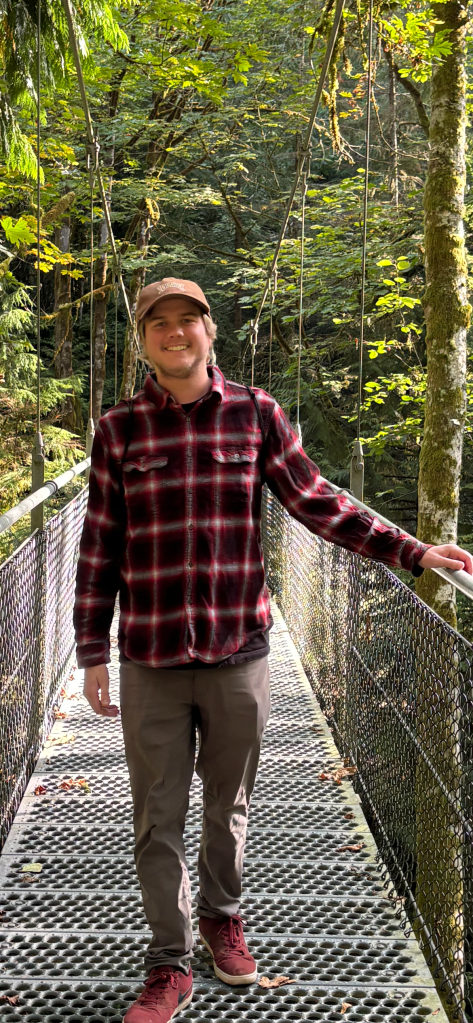
Bryan Blau – Bryan is investigating groundwater carbon and groundwater sources in shallow aquifers of Cache Valley. Other research interests include how carbon storage within rivers, lakes, and oceans and how this is impacted by humans. A fun fact about Bryan is that he has a scar across his head from a rock and how he has an undergraduate degree in Geology (from USU)!
Undergraduate Students
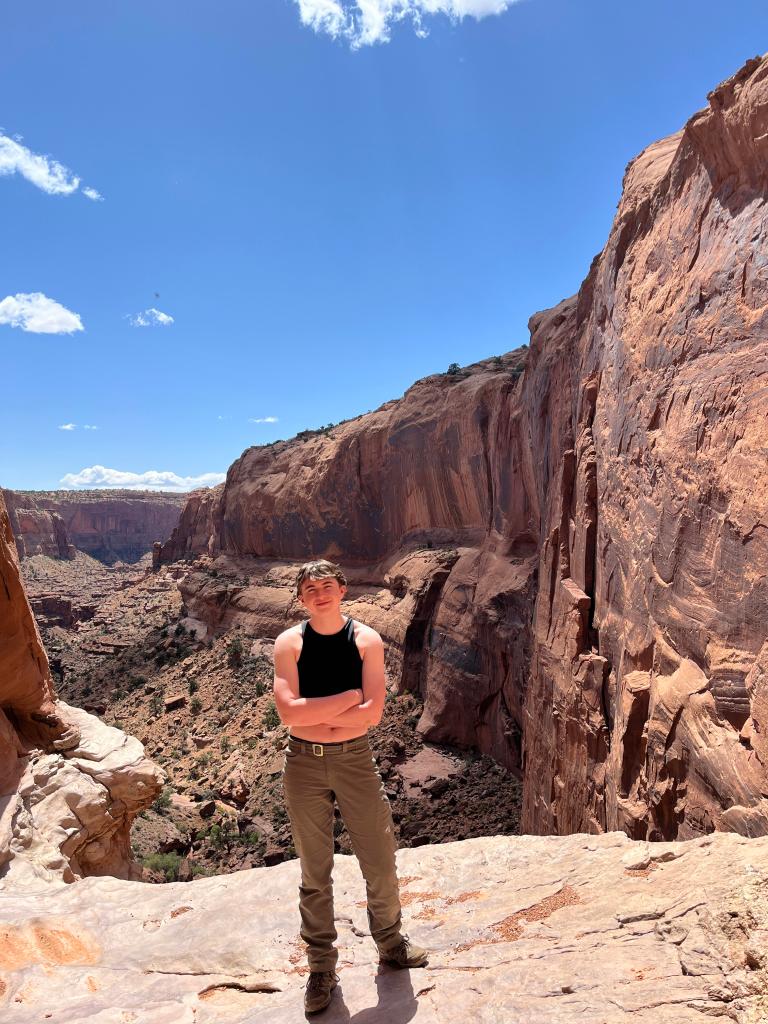
Ash Rogers – Ash worked as an undergraduate research assistant in the summer 2025. Ash is heading into his sophomore year at USU, majoring in Geology with a Professional Emphasis. In his free time, Ash enjoys ham mocking, backpacking, and canyoneering – occasionally combining all three in ridiculous ways.
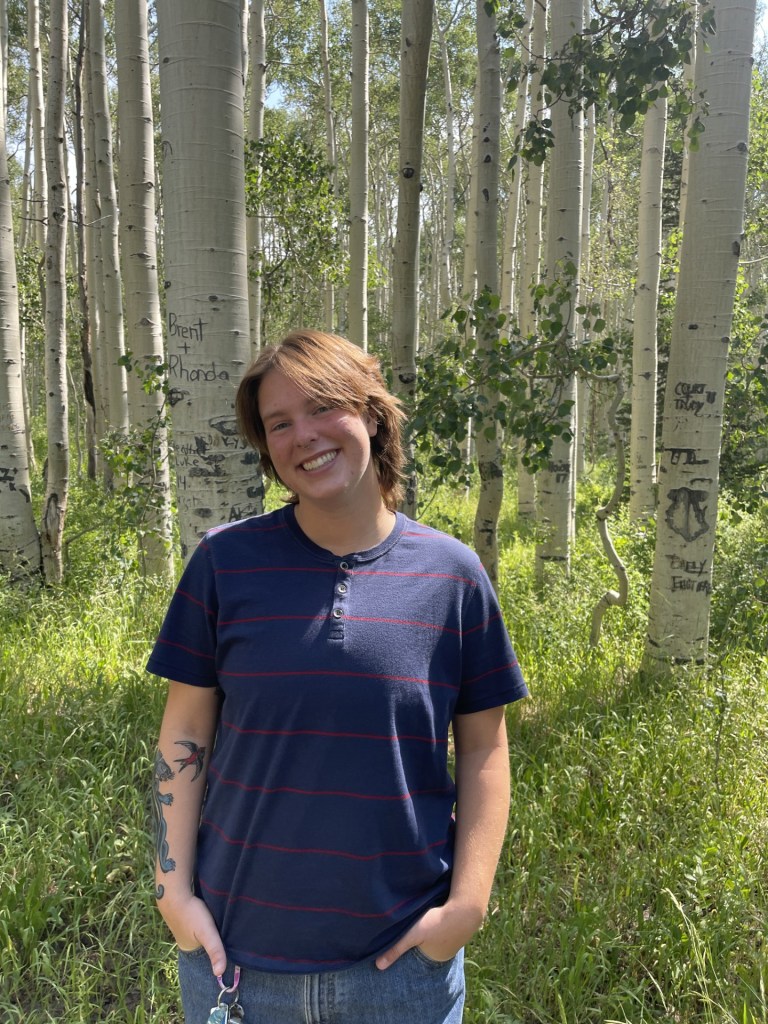
Maya Cottam – Maya is from Austin, Texas and is studying Climate Science at USU, with minors in Mathematics and Landscape Architecture. They are interested in oceanography, specifically in the carbon cycling between the ocean and atmosphere and hope to one day do climate research in Antarctica. Maya enjoys swimming, hiking, writing, collaging, and skiing. Fun fact about Maya: they have two guinea pigs!
Interested Students:
I am currently not looking for new graduate students at this time but would welcome any student that may have their own grants or fellowships. If you are interested in being a graduate student in the future, feel free to email Dr. Vaughn with a CV and a brief personal statement including your research interests and career goals. The students in my lab will be based in the Geosciences Department (https://www.usu.edu/geo/) at Utah State University (Logan, UT) and will work under my supervision. At Utah State University, the student will be able to become an affiliate of the Ecology Center (https://www.usu.edu/ecology/) at Utah State University and will have an opportunity to participate in the Climate Adaptation Science Program – a 9-credit interdisciplinary specialization/minor that provides students with direct experience in actionable science.
The specific thesis topics will be determined between the supervisor and student based on the candidate’s interests and strengths. Potential research projects include:
- Carbon cycling (carbon burial in soils, carbon export to the oceans, greenhouse gas emissions) in coastal blue carbon ecosystems with the potential for national and international collaborations.
- Influence of climate change on carbon cycling in aquatic systems found in U.S. drylands (e.g. lakes, ephemeral streams), particularly the impacts of increasing drought and wildfire frequency.
- Impacts of land-use change (urban development, agriculture) on aquatic carbon cycling.
Outside of their research projects, students will also be involved with other projects in the lab, including field data collection campaigns, laboratory analyses, and data management and interpretation. Students will be expected to present their findings at national or international conferences and publish in peer-reviewed scientific journals. Students will be supported financially, including tuition support, stipends, travel support (both field and conference travel), and will have support for appropriate supplies/equipment.
 Vaughn Biogeochemistry Lab